Most decor guides assume that you can drill, paint, and fix freely. In rentals, every intervention is negotiated with a lease and an inventory. Yet it is within this constraint that decorative choices become the most interesting, as they require working with materials, light, and volumes without touching the structure.
Decor in rental housing: enhancing an interior without structural modifications
A tenant who installs a wall shelf risks their security deposit. The basic rule is simple: everything that is fixed must be removable without a trace. This excludes large diameter anchors, rods screwed into the ceiling, and most picture rails glued onto old plaster.
We recommend structuring the decor around three levers compatible with a standard lease: heavy textiles, autonomous lighting, and freestanding furniture. A thick linen curtain hung on a tension rod between two walls creates a room separation without drilling. An adjustable floor lamp replaces a recessed spotlight. A tall bookshelf placed against a bare wall serves as a picture rail if you lean frames simply resting on the shelves.
Heavy-duty adhesive strips can hold a frame weighing several kilograms on a smooth wall. On a textured plaster, they may come loose in a few weeks. Before purchasing, test the surface with a sample strip in a less visible corner. To discover decor with Protect Habitation, this logic of reversibility guides the selection of products and techniques.
Color palette and textiles: creating an ambiance without repainting
Repainting the walls remains the most spectacular transformation, but leases often prohibit it (or require returning to the original color). Textiles then become the main vector of color in the room.
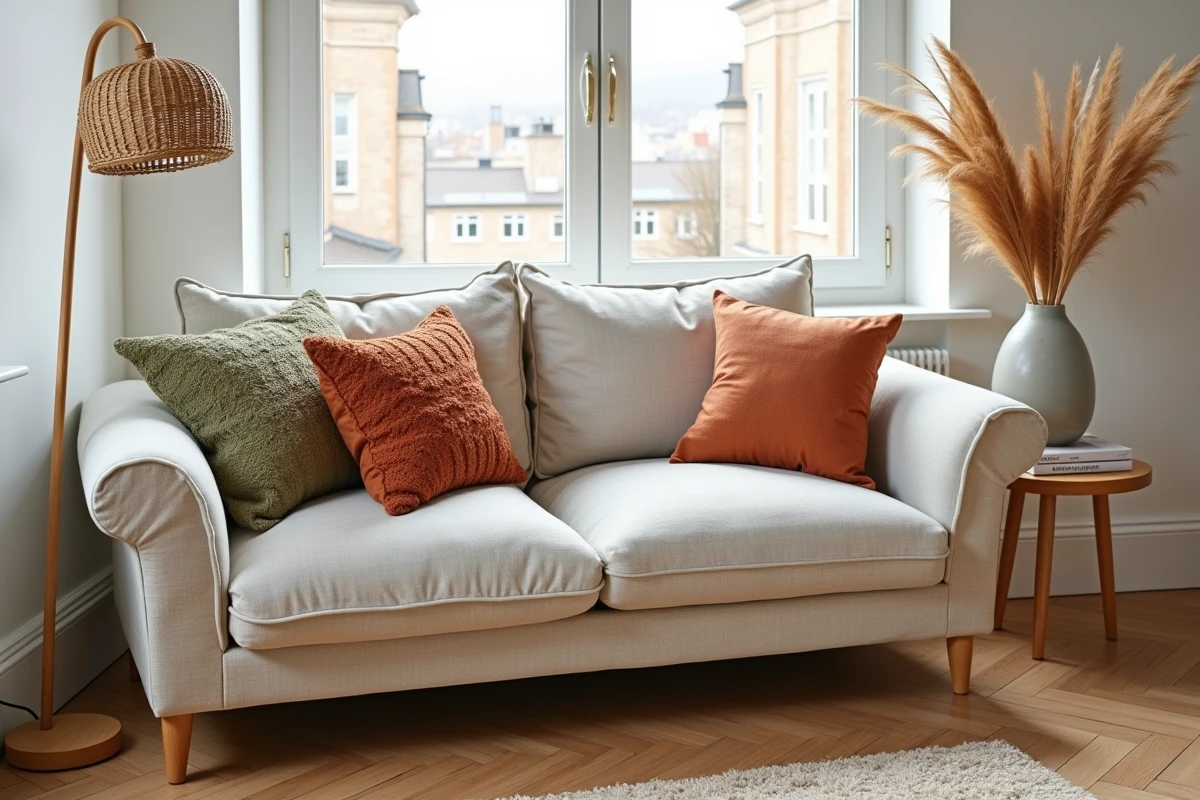
A neutral sofa takes on a whole new dimension with corduroy cushion covers in ochre or terracotta tones. The IKEA report “Wellbeing Homes” (2026 edition) notes a trend of reduced stress among occupants using these earthy tones in living spaces, based on qualitative feedback from Northern Europe.
Textile layering for a living room without paint
The principle is to create depth through successive layers. A dark, low-pile rug visually anchors the living room. On top, a boucle wool throw adds texture. The curtains, in an intermediate tone, unify the whole.
- Choose a rug whose darkest shade provides the “visual floor” of the room, regardless of the actual flooring
- Limit the textile palette to three close tones (one dark, one medium, one light) to avoid a cluttered effect
- Prefer machine-washable materials if the home accommodates children or pets, as textiles absorb odors much faster than paint
This approach also works in a bedroom. A wrinkled linen bedspread, two contrasting pillowcases, and a folded throw at the foot of the bed are enough to give character to a room with white walls.
Decorative lighting: replacing ceiling fixtures without electrical intervention
A central ceiling light casts flat light that flattens the volumes. In a rented property, you cannot move the light point. The solution lies in multiplying low sources.
An arc floor lamp positioned behind an armchair creates a reading nook with warm directional light. A battery-operated LED string light fixed along a shelf highlights a wall without wiring. A ceramic table lamp, placed on an entry console, replaces the fluorescent light in the hallway.
Color temperature and material rendering
The temperature of the bulb radically changes the perception of textile materials and furniture. Below 3,000 kelvins, warm tones stand out and wood gains depth. Above 4,000 kelvins, the ambiance turns clinical.
We observe that many tenants keep the bulbs provided by the landlord, often cold white LED tubes. Replacing all the bulbs in an apartment with 2,700 K models costs less than a single designer cushion, for a much greater visual impact.
Kintsugi and visible repair: an alternative to replacing decorative objects
The Japanese techniques of kintsugi, which involve repairing a broken object by highlighting the fracture with a gold joint, apply to home decor beyond just ceramics. A chipped vase repaired with gold-tinted resin becomes a unique piece. A split wooden frame, reinforced with a brass inlay, tells a story that new items do not.
Visible repair transforms a flaw into a decorative element, which is perfect for a tenant’s budget. Rather than replacing a damaged item with a low-quality equivalent, manual restoration produces a unique result at a lower cost.
- Consumer kintsugi repair kits contain epoxy resin, metallic powder, and a fine brush, for use on ceramics, stoneware, or porcelain
- On wood, a similar technique involves filling cracks with a mixture of glue and brass powder, then sanding for a smooth finish
- The wabi-sabi approach (acceptance of imperfection) applied to home decor reduces the temptation for decorative overconsumption, a point documented in the book “Wabi-Sabi for Artists, Designers” by John Pawson (2025 edition)
Furniture and living room layout: optimizing space without wall fixing
A wall-mounted TV unit frees up floor space but leaves four holes to fill initially. A low freestanding unit on thin legs produces the same effect of visual lightness without any fixing.
In a narrow living room, position the sofa perpendicular to the longest wall rather than flush against it. This simple change of axis creates two zones (relaxation corner and passage) and gives an impression of depth. Add an open console behind the back of the sofa to place decorative objects and delineate the space.
The decoration of a rental interior relies on precise gestures rather than heavy transformations. Changing bulbs, layering coherent textiles, repairing rather than discarding, repositioning existing furniture: these reversible interventions profoundly alter the ambiance of a room without leaving a trace on the walls.