
The quality of family life on a daily basis relies less on grand outings and more on the repetition of well-calibrated micro-interactions. We observe that the households that function best share a common point: an attention to the attentional availability of parents, not just to the rules imposed on children.
Parental technoférence and family climate: the real lever to activate
The use of smartphones by parents during family time has a name in psychology: technoférence. Research published in the Journal of Family Psychology in 2022 associates this massive use with increased conflicts and oppositional behaviors in children.
The problem is not limited to children’s screen time. The High Council of Public Health published updated recommendations in 2023 that emphasize parental co-presence: watching content with the child, commenting together, rather than simply setting a maximum duration. The attentional availability of the parent is as important as screen rules.
Specifically, we recommend treating the parental smartphone as a full-fledged family parameter. Putting your phone in another room during meals or the evening ritual produces measurable effects on children’s cooperation because the signal sent is one of full presence. Several specialized resources detail these family dynamics, such as the Maman du Quotidien website, which addresses parenting from a practical and daily perspective.
Parental mental load: concrete distribution rather than good intentions
The 2023 survey by UNAF confirms a reported increase in the feeling of mental load among parents, particularly mothers. The link between organizational overload and marital tensions is documented. We find that the usual advice (“share the tasks”) fails due to lack of method.
Making the mental load visible is the first step. This involves a written inventory of all the invisible micro-tasks: making medical appointments, tracking food supplies, managing extracurricular activities, anticipating seasonal clothing.
- List logistical tasks each week on a shared platform (board, collaborative app) so that each parent sees the entire scope.
- Assign complete domains rather than isolated tasks: one parent fully manages medical follow-up, the other the activities, to eliminate cross-supervision.
- Include children as soon as they are able, not to lighten the parents’ load, but to develop their sense of collective responsibility.
This domain-based approach reduces friction because it eliminates the need to remind, check, or follow up. The parent responsible for a domain makes decisions without validation from the other.
Family communication: active listening and structured moments
Families that communicate well are not those that talk the most, but those that have dedicated spaces for conversation. A ritualized speaking time, even brief, creates more bonds than a permanent but vague availability.
We recommend a simple format: an open question asked each evening at dinner, rotating among family members. “What surprised you today?” works better than “How was your day?” because the specific question invites a specific answer.
Managing conflicts between children without systematic arbitration
Intervening too quickly in sibling disputes deprives children of social learning. As long as physical safety is not at stake, allowing children to attempt resolution themselves develops their negotiation skills.
The parental role then consists of reformulating what each person feels, without making a judgment. “You are angry because your brother took your toy” sets an emotional framework without designating a culprit. This active listening posture requires resisting urgency, but it reduces the frequency of conflicts in the medium term.

Regular family activities: ritualize without rigidifying
Family rituals secure children and strengthen the sense of belonging. The challenge is to maintain them without turning them into an additional burden for already overwhelmed parents.
A good family ritual lasts less than thirty minutes and requires no preparation. Here are a few formats that withstand wear:
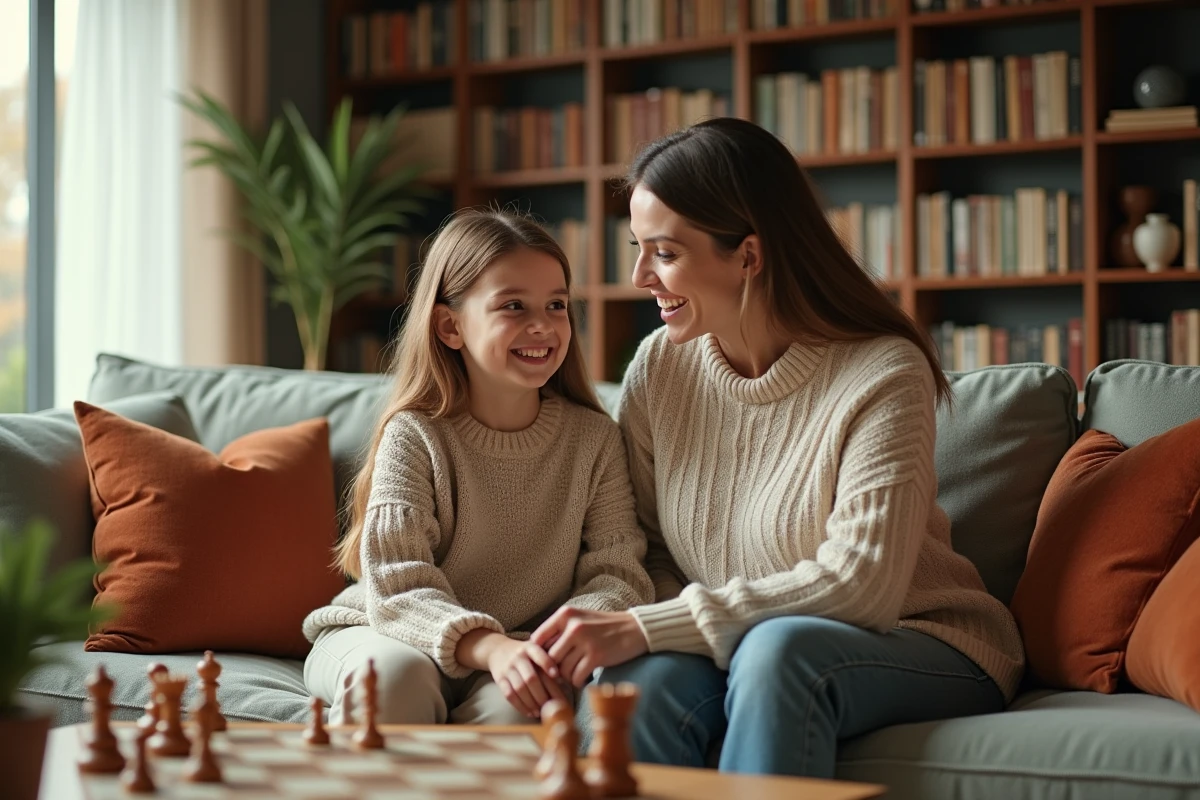
- A short board game on Sunday evening, chosen in turn by each family member.
- A weekly walk in a different location each time, with no performance or distance goals.
- A shared reading moment where everyone reads their own book in the same room, creating closeness without forced interaction.
The classic trap is to multiply activities thinking that quantity strengthens bonds. It’s the opposite. One ritual consistently maintained over several months creates more memories and stability than five activities abandoned after three weeks.
Balance between professional life and family moments
The boundary between professional life and family life blurs with remote work. Children perceive the physical presence of the parent as availability, which generates frustration when the parent works behind a screen at home.
We recommend physically marking the transition: closing the office door, changing clothes, or simply announcing “I am available now.” This signal of transition between the two spheres protects the quality of family moments.
A thriving family life relies on fine, repeated adjustments tailored to each family configuration. Parents who achieve the best results are those who accept regularly modifying their routines rather than seeking a perfect and definitive system.