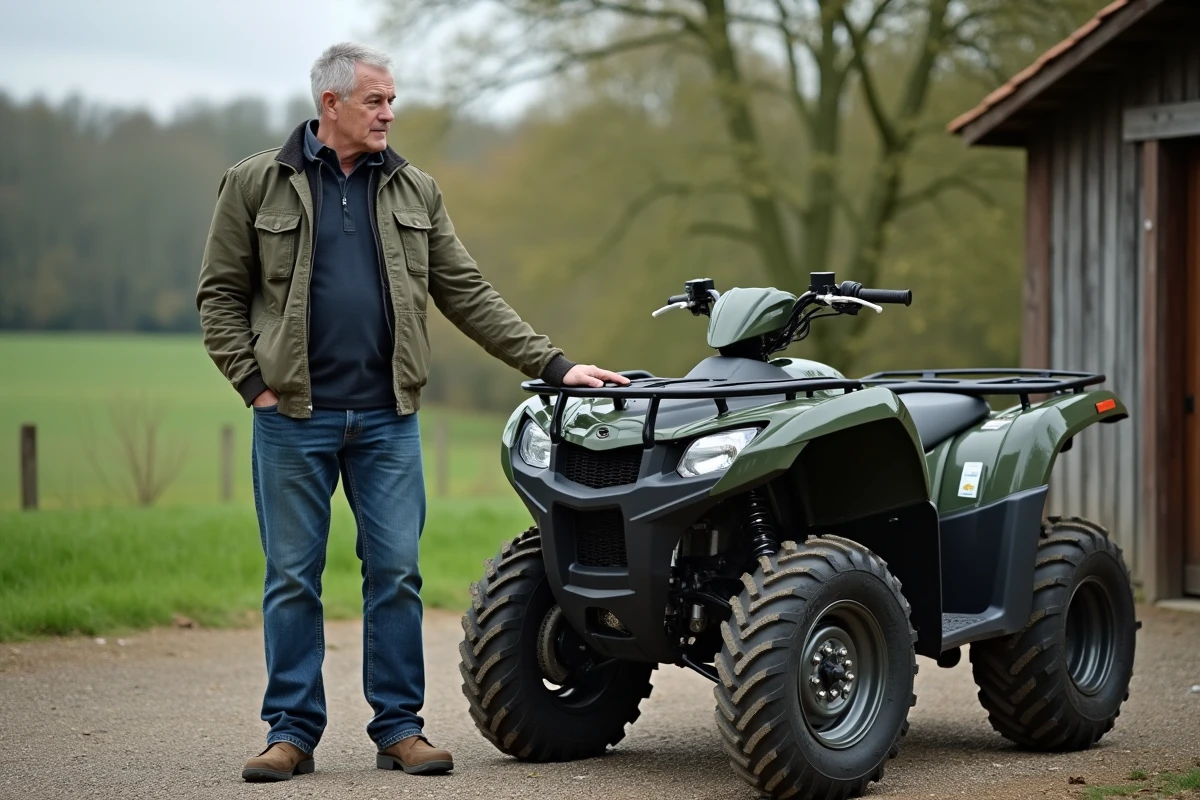
Selling a non-homologated quad in France? Legal, but double-edged. While the transaction is not prohibited, the buyer faces serious restrictions: it’s impossible to ride anywhere other than on private land, and offenders risk much more than just a warning.
Some sellers conceal the constraints that weigh on this type of sale, exposing the buyer to the unpleasant surprise of an infraction as soon as they venture off private land. The law strictly regulates this market: mandatory procedures, precise formalities, and very real risks in case of negligence. The slightest misstep can be costly.
Non-homologated quad: definition, possible uses, and regulatory limits
A non-homologated quad has not received official authorization to leave private land. Its design, equipment, or engine do not meet the registration requirements. As a result, its place is limited to the family property’s gate or on the tracks of a recognized sports association. Simply crossing a road or path can lead to vehicle seizure, heavy fines, or, at worst, the outright destruction of the quad.
New regulatory development: every machine exceeding 25 km/h must be declared. The buyer has 48 hours after acquisition to register on DICEM, authenticate via FranceConnect, and then fill out the Cerfa 13853 form. A unique identification number will be assigned, to be engraved on a fixed part and placed on a plate: there’s no way around it. Forgetting this step can increase the fine up to 750 euros and expose the quad to impoundment or even confiscation.
It is impossible to overlook civil liability insurance. Even for leisure on private land, a declaration and appropriate coverage are required. Without these guarantees, any accident results in a refusal of coverage. Motorized rodeos can lead to imprisonment and vehicle seizure: a risk that should never be underestimated.
For those wanting to clear up the confusion, the article can you sell a non-homologated quad provides a comprehensive overview of the process and rules to follow. Scrupulously applying the new regulations is not optional: it’s the only way to avoid trouble, regardless of your role in the transaction.
Sale: legal obligations and possible sanctions
Transferring a non-homologated quad to another person requires the utmost attention. A vehicle without a registration certificate can only be legally transferred to an authorized professional or a Vehicle Off the Road (VHU) center. Conducting a private sale exposes you to a sanction that goes beyond just a fine. Nevertheless, the declaration of transfer via the Cerfa 15776 form remains mandatory for every sale: this document precisely identifies the seller and buyer, ensuring the traceability of the vehicle.
A firm point: selling to a minor under 14 years old is prohibited. If the seller crosses this red line, they take on liability, expose the quad to seizure, and the insurance is void at the slightest incident.
Putting a used quad on the market without adhering to the established framework closes the door to insurance and risks assuming full responsibility in case of an incident. The decree n° 2022-1040 prohibits any approximation. Transparency is required: without compliance with obligations, the sale can be reported at any time.

How to regularize or homologate a non-homologated quad?
If the goal is to regularize the status of a non-homologated quad, several steps are necessary. First step: check if the vehicle meets the technical standards to allow road circulation. This includes brakes, headlights, turn signals, mirrors in impeccable condition, a power limit of 20 HP, and a weight not exceeding 400 kg. If the criteria are not met, homologation remains out of reach.
When the vehicle is compliant, a certificate of conformity must be requested from the manufacturer or their representative, which paves the way for obtaining a registration certificate. The file must include: Cerfa 13750 form, identity documents, and proof of residence, and then be submitted on the ANTS (National Agency for Secure Titles) website.
Without a certificate of conformity, the individual homologation begins. This involves heavy technical inspections, passing before an approved body, often discouraging delays, and costs that can sometimes exceed the value of the quad. Most attempts fail: in this case, only use on private land or within a recognized sports association remains authorized. But one step remains imperative: declare the vehicle within 48 hours on DICEM, engrave the unique number, and install the plate.
To help clarify your steps, here is the timeline to follow:
- Assess the technical compliance of the quad
- Obtain the certificate of conformity or initiate an individual homologation process
- Submit a request for a registration certificate via ANTS
- Make the declaration on DICEM, even for any non-homologated quad
No matter the solution, riding without appropriate civil liability insurance, even on private land, exposes you to immediate consequences: monetary penalties, impoundment, or even outright confiscation of the vehicle. As soon as the quad leaves the barn, it’s best to keep in mind that the law never backs down, even in the dust of the paths.