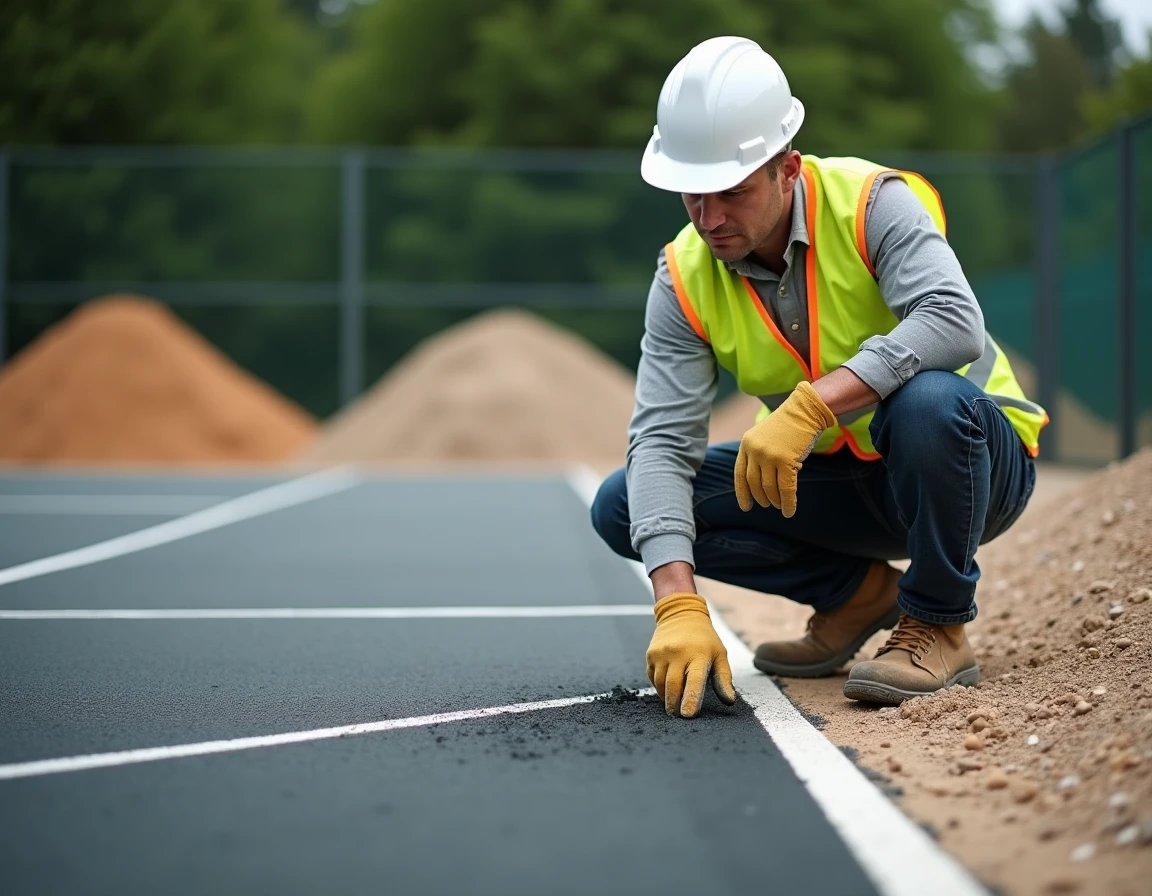
A private or public tennis court represents a waterproofed surface of several hundred square meters, laid on soil whose mechanical properties vary from one plot to another. Successfully constructing a tennis court requires coordinating expertise in geotechnics, hydraulics, and surface selection, three areas rarely mastered by a single general contractor. Engaging a specialized builder is not a matter of convenience; it is a technical necessity.
Local soil engineering and court failures: the real risk factor
The majority of failures observed on so-called “premium” courts stem from a poor adaptation of the structure to the local soil. Expansive clays, flood-prone areas, heterogeneous soils: each configuration requires distinct responses (enhanced drainage, decoupled slab, expansion joints). A builder who applies a standard scheme without prior geotechnical study exposes the project to cracks, subsidence, or slab heaving within a few seasons.
Selecting a professional who masters this soil engineering adapted to the local context is the first filter in the selection process. Before any quote, ensure that a soil study is included in the service, and that the builder has previously completed projects on soils comparable to yours. Field feedback varies on this point: some providers charge for it as an option, while others include it by default.
Engaging the construction of a tennis court with a professional who does not mention the geotechnical analysis from the first commercial exchange should raise alarms. This aspect, often perceived as ancillary, conditions the durability of the entire structure.
Rainwater management on an outdoor tennis court
An outdoor tennis court waterproofs a significant surface. Local regulations in France increasingly require projects to incorporate rainwater management and runoff systems. Ignoring this constraint can block the issuance of the permit or the prior declaration of works.
The professional builder must size the drainage system according to the local rainfall regime and the absorption capacity of the surrounding soil. Depending on the municipality, requirements vary: on-site retention, infiltration via landscaped swales, connection to the network. Each solution has different costs and space requirements.
This technical subject is often the most underestimated in projects. Poorly calibrated drainage is not visible at the project handover; it reveals itself during the first episode of heavy rain when the surface remains unplayable or water stagnates at the edges.
Tennis court surface: clay, resin, synthetic grass, or modular PVC
The choice of surface determines gameplay behavior, maintenance frequency, and overall cost over the court’s lifespan. Four families dominate the French market:
- Clay: recognized joint comfort, slow bounce, but daily maintenance (watering, brushing, seasonal restoration). Unsuitable for projects without dedicated maintenance staff.
- Acrylic resin: versatile, available in several levels of roughness, limited maintenance. Sensitive to cracking if the underlying slab shifts.
- Synthetic grass: fast bounce, good weather resistance, sand filling required. Lifespan varies depending on fiber quality.
- Modular PVC sports floors: manufacturers like LKM Floor offer snap-on or glued surfaces, originally designed for basketball or volleyball, but starting to appear on recreational tennis courts. The advantage: reducing heavy civil engineering work and construction time.
No surface is universally superior. The choice depends on the desired level of play, climate, annual maintenance budget, and slab structure. A specialized builder presents these trade-offs with durability data specific to each solution, not with generic commercial arguments.
Multi-sport courts: tennis, padel, and pickleball on the same footprint
The recent trend in private projects, particularly in high-end residences and hospitality, is to design modular surfaces compatible with multiple sports (tennis, padel, pickleball). The goal is to maximize land investment and anticipate evolving usage.
This versatility imposes technical compromises. The dimensions of a padel or pickleball court differ from those of a tennis court. The surface must tolerate varied mechanical stresses. Fences, nets, and markings must be adaptable without heavy work.
A builder capable of delivering a functional multi-sport court does not simply draw multiple sets of lines on the same slab. They size the structure, drainage, and peripheral equipment so that each sports configuration remains playable under acceptable conditions. The available data does not yet allow for conclusions about the long-term durability of these hybrid installations, due to insufficient feedback on projects delivered in France.
Selecting the tennis court builder: technical criteria to verify
Beyond the price per square meter, several elements distinguish a reliable provider from a general construction contractor who adds tennis courts to their catalog:
- Systematic inclusion of a geotechnical study in the initial quote, not as an option.
- Verifiable references on soils similar to yours (clay, fill, rock, high water table).
- Mastery of local administrative procedures: urban planning permits, rainwater management obligations, accessibility for people with reduced mobility if applicable.
- Specific ten-year warranty for sports structures, distinct from a generic ten-year building warranty.
- Ability to present several surface options with their implications for maintenance and costs over ten years, not just the installation price.
The French market for tennis court builders remains fragmented, without a central aggregator or unified sector label. Selection therefore relies on directly verifying technical skills and past achievements, project by project.
A well-constructed court is judged after several winters, not at the project handover. The choice of professional impacts the quality of play and the longevity of the structure over a period that far exceeds the construction phase.