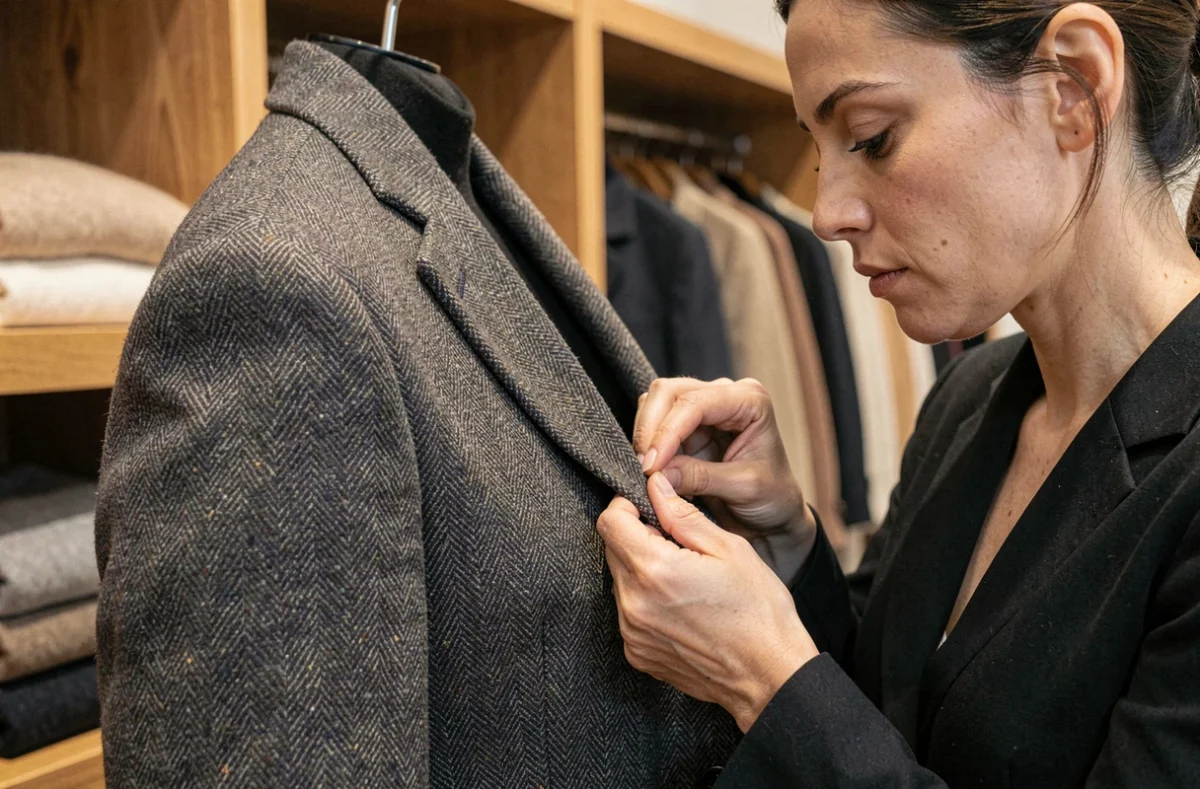
The quality of a garment is not limited to its brand or price. It relies on a set of technical characteristics that can be verified before purchase: fabric density, seam regularity, fiber nature, and washing behavior. Recognizing these indicators allows you to build a sustainable wardrobe, made up of pieces that retain their shape and appearance season after season.
Fabric Weight and Density: The First Test Before Purchase
Fabric weight, expressed in grams per square meter, determines the hold and longevity of a textile. A fabric that is too light for its function (a coat, tailored pants) will deform quickly. Conversely, a t-shirt with sufficiently dense fabric weight will maintain its structure after dozens of washes.
To assess density without instruments, one simple action is enough: hold the fabric up to a light source. If light passes easily through the fibers, the weave is loose and the piece will age poorly. An opaque fabric with a tight weave resists friction and pilling better.
This test works equally well on cotton, wool, or linen. It does not replace reading the label, but it complements the information: two cotton t-shirts with identical compositions can have very different weights and thus vastly different lifespans. Reviews on superior quality on Ce Qu’il Faut Savoir detail the selection criteria material by material.
Seams and Finishes: What the Inside of a Garment Reveals
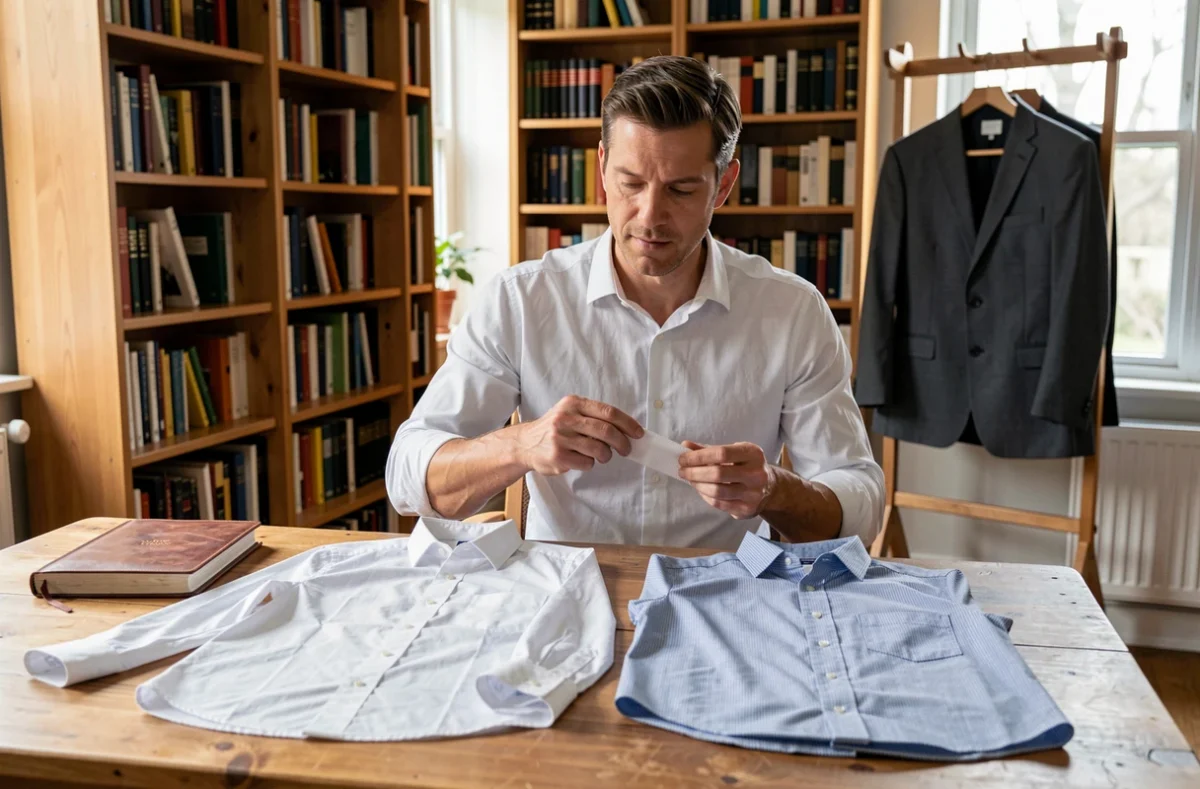
Always turn the garment inside out before trying it on. The inside is the x-ray of the manufacturing process. Three elements deserve particular attention.
- The regularity of the seams: irregular stitches, uneven spacing, or threads sticking out indicate sloppy craftsmanship. On a well-assembled garment, the seams form a continuous and uniform line.
- Seam allowances (the fabric margin beyond the stitching): a generous allowance allows for hemming or slightly widening a piece. A nearly nonexistent allowance indicates a very tight cut to save fabric, at the expense of repairability.
- Reinforcements at stress points: armholes, crotch, pockets. These areas endure the strongest mechanical stresses. Double stitching or topstitching in these places is a sign of quality, not just a cosmetic detail.
Buttons also provide reliable clues. A button sewn with a shank (a small space between the button and the fabric) is more resistant to pulling than a button sewn directly onto the fabric. Neatly finished buttonholes, without loose threads, confirm a high level of finishing.
Fiber Composition: Reading the Label Beyond the Percentage
The nature of the fiber influences comfort, maintenance, and durability. Natural fibers (cotton, linen, wool, silk) breathe better and age more predictably than most synthetic fibers. A blend of fibers is not necessarily a bad sign: a small percentage of elastane in jeans improves comfort without compromising fit, provided that cotton remains the predominant fiber.
The problem lies in blends where synthetic fibers dominate. A sweater labeled as “wool” but made up of more than half acrylic will pill quickly and retain odors. Checking that the noble fiber represents the dominant part of the blend is a simple reflex that avoids disappointment.
What the Label Doesn’t Yet Say (But Soon Will)
As of October 1, 2025, brands can voluntarily display an “environmental cost” calculated using the public method Ecobalyse. This score is not limited to composition: it includes climate impact, water consumption, biodiversity, repairability, recycling, and even microfibers released during washing.
From October 1, 2026, a brand that already communicates an environmental indicator must simultaneously display the official score. A third party (consumer, association, distributor) can also use the information visible on the label to calculate the score via Ecobalyse, even if the brand does not provide it. This system reduces reliance solely on manufacturers’ claims and offers a concrete comparison tool before purchase.
Fit and Adjustment: The Criterion That Online Photos Don’t Show
A high-quality garment falls correctly on the body without pulling or gaping. The shoulder seams should stop at the edge of the shoulder, not extend down the arm. The collar of a shirt should hug the neck without being tight or gaping.
A garment that requires minor alterations is still a good choice if the material and finishes are up to standard. Shortening pants or adjusting a waist is inexpensive compared to the cost of replacement. The presence of sufficient seam allowances (mentioned earlier) determines the feasibility of these alterations.
When trying on, move: raise your arms, sit down, walk. A quality fabric moves with you and returns to place. A poor-quality fabric retains creases, shows marks at the knees and elbows, and loses its shape after the first day of wear.
European Digital Passport: A Future Verification Tool
The European regulation ESPR provides for the introduction of a digital product passport for textiles. This system will make verifiable data on composition, origin, chemical treatments, and recyclability accessible via a QR code. The aim is to shift quality control towards traceable information rather than relying solely on marketing promises.
This digital passport will complement the French environmental display. The combination of the two tools will allow for comparison of pieces not just on their appearance or price, but on standardized data. For the consumer, this means an increased ability to distinguish a sustainable garment from one designed for rapid obsolescence.
The quality of a garment can be verified with your hands, eyes, and the label. The regulatory tools that are coming will make this verification more systematic, but basic actions—turning the garment inside out, testing fabric density, reading the composition—remain the most reliable filter at the time of purchase.