
The fault code 1525F3 on Renault frequently sparks discussions on automotive forums, almost always in the same context: an oil change or battery replacement has just been performed, and the engine light comes on. The ECU reports an inconsistency between the acceleration data and the engine torque management. The vehicle enters limp mode, the cruise control deactivates, and power drops. In most cases, the problem does not stem from a faulty part.
Code 1525F3 and CAN network: why the fault is not always where you look for it
On recent Renault vehicles, the code 1525F3 does not necessarily point to a faulty mechanical component. It corresponds to invalid data received on the CAN network by the engine ECU, which then loses confidence in the acceleration information transmitted by other modules.
The system reacts by disabling the cruise control or speed limiter as a safety measure. Therefore, the fault may originate from the engine, the electrical supply, or any other ECU, without the cruise control switch itself being at fault.
This logic of secondary faults explains why a simple reset with an OBD scanner does not provide a lasting solution. The code reappears as soon as the ECU detects the inconsistency again.
Before replacing anything, it is essential to identify the initial cause of the communication breakdown. This is precisely where oil change or battery replacement interventions come into play. A detailed guide lists the mistakes to avoid with the Renault code 1525F3 in these two specific situations.
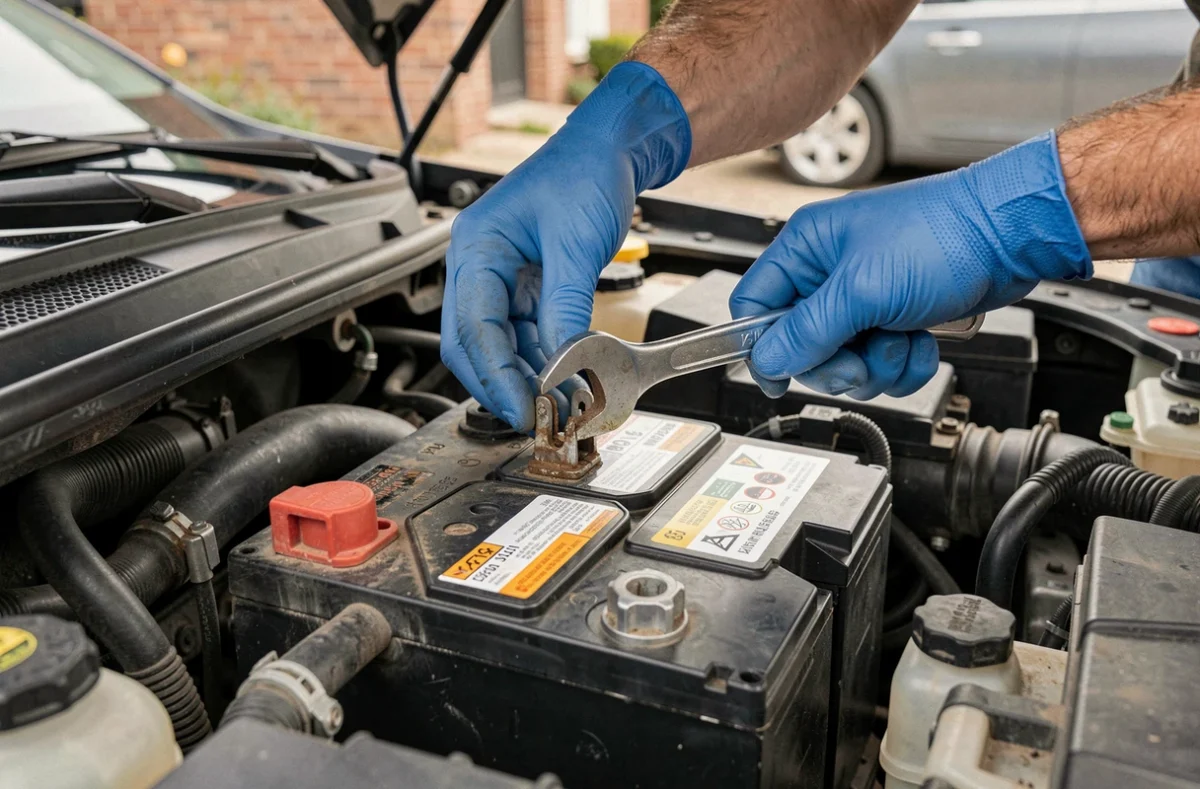
Renault battery replacement: the loss of adaptive throttle values
Replacing a battery seems trivial. On a multiplexed vehicle, the power cut can erase the adaptive values stored by the engine ECU. These parameters, accumulated over the kilometers, calibrate the idle, the throttle response, and the position of the accelerator pedal sensor.
Without this data, the engine may exhibit unstable idle, stalling on startup, or erratic throttle response. The ECU interprets these inconsistencies as a fault and triggers the code 1525F3.
Three common mistakes during replacement
- Disconnecting the battery without a voltage maintenance device (memory cable or auxiliary charger), which causes the complete loss of throttle and idle learnings
- Installing a battery whose capacity or resting voltage differs from the vehicle specifications, creating fluctuations that disrupt communication between ECUs
- Not performing the throttle relearning procedure after reconnection, assuming the ECU will recalibrate itself while driving
The relearning procedure varies by model. It generally involves turning on the ignition without starting, waiting a few seconds, and then following a specific sequence (throttle released, ignition off, restart). Without this step, the code 1525F3 may reappear with each driving cycle.
Engine oil change and code 1525F3: the role of displaced connectors
The link between an oil change and an electronic fault seems counterintuitive. The fault does not come from the oil itself, but from what was touched during the intervention.
According to documented field feedback, a sensor connector that is not properly reconnected after being moved to access the oil filter or drain plug is enough to cause a micro-disruption of the signal. On some models, the oil pressure sensor or air flow meter is located very close to the work area.
Concrete checks after an oil change
Before launching into an extensive electronic diagnosis, a methodical visual inspection can eliminate the simplest causes:
- Check that each connector accessible in the engine area is properly clipped, especially those of the accelerator pedal sensor and throttle body
- Ensure that no vacuum hose has been disconnected or pinched during the filter handling
- Inspect the battery terminals and engine ground wires for any loose connections caused by tools during the operation
- Make sure the oil level is correct, as an excess can generate internal overpressure detected by the ECU
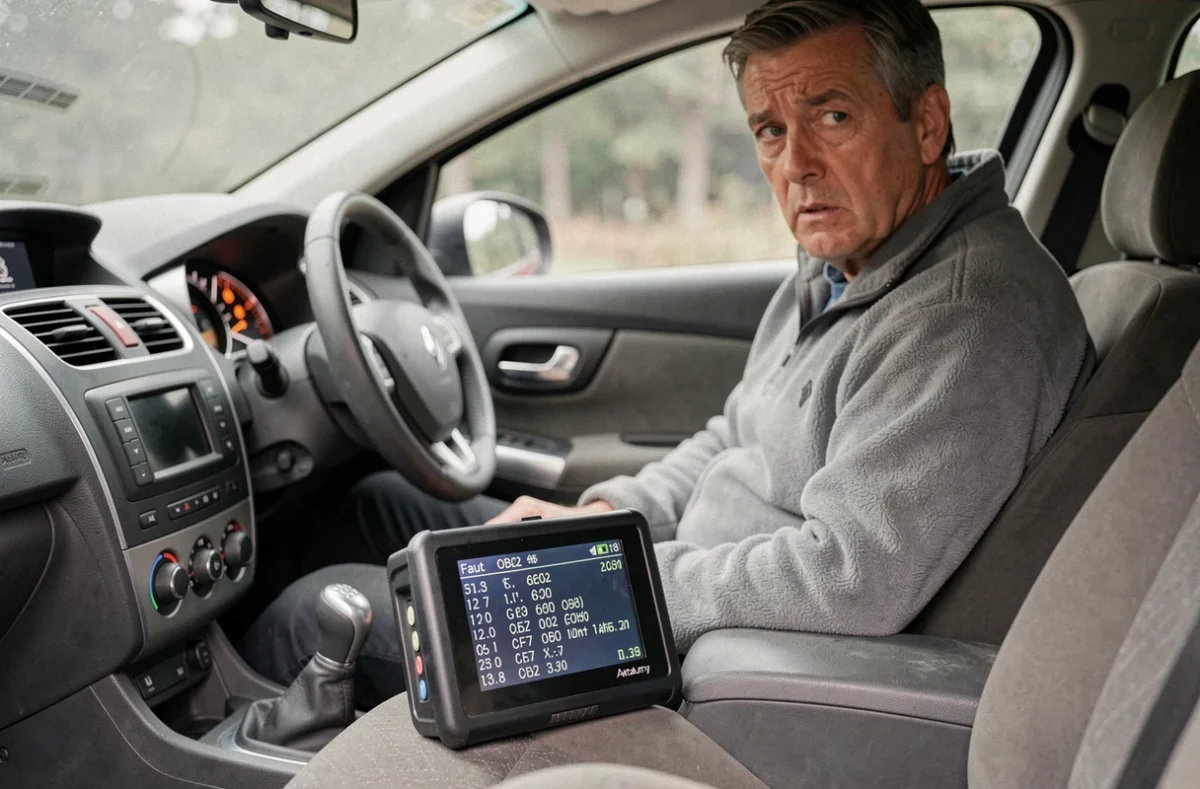
Diagnosis of code 1525F3: distinguishing a residual fault from a real failure
After checking the connectors and performing the throttle relearning, the code may persist. It is then necessary to determine whether it is a residual fault stored in memory or an active problem.
An OBD tool capable of reading Renault manufacturer codes (not just generic codes) allows for distinguishing between the two situations. A stored but inactive fault indicates that the initial problem has been corrected, but the ECU’s memory has not been cleared. A permanent fault signals an inconsistency that is still present.
Field feedback varies on one point: some vehicles require several driving cycles (starting, driving, stopping) before the ECU validates the disappearance of the fault and turns off the light. Others require a manual reset with a scanner followed by a confirmation road test.
The resting voltage of the battery also deserves checking. Below a certain threshold, the CAN network can generate intermittent communication errors that the ECU interprets as an engine fault. A new but poorly charged battery upon installation can produce exactly this scenario.
The code 1525F3 after a routine intervention almost never justifies the immediate replacement of a sensor or throttle body. The logical sequence remains the same: check the connectors, monitor the battery voltage, perform the relearning, then drive before reading the codes again. Most 1525F3 faults post-intervention disappear without part replacement, provided these steps are not skipped.