
Building a house typically involves around twenty participants over a period that often exceeds twelve months. Between the first shovel of dirt and the handover of keys, several friction points go unnoticed by future homeowners, particularly in terms of insurance and the reception phase. The French regulatory framework protects the project owner, provided they activate the right levers at the right time.
Construction Damage Insurance: An Often Overlooked Obligation Before the Project
Most construction guides detail the builder’s guarantees (ten-year, perfect completion, good functioning). However, they quickly skim over the insurance that the project owner must subscribe to: construction damage insurance must be taken out before the project begins.
Its role is clear: it pre-finances repairs covered by the ten-year guarantee without waiting for a court to designate the responsible party. Specifically, if a structural crack appears three years after the reception, the construction damage insurer compensates first, then seeks reimbursement from the builder or their insurers.
Failing to take it out exposes the owner to two risks. The first is financial: in the event of a serious loss, the owner pays for repairs upfront and engages in a lengthy procedure. The second is legal: reselling the property may be complicated, as the next buyer inherits a coverage defect.
Checking the subscription of this insurance before signing the service order for the project is a reflex to adopt from the project planning phase. To delve deeper into the various construction configurations and associated points of vigilance, the house page of Bien Construire! details these topics in a structured manner.
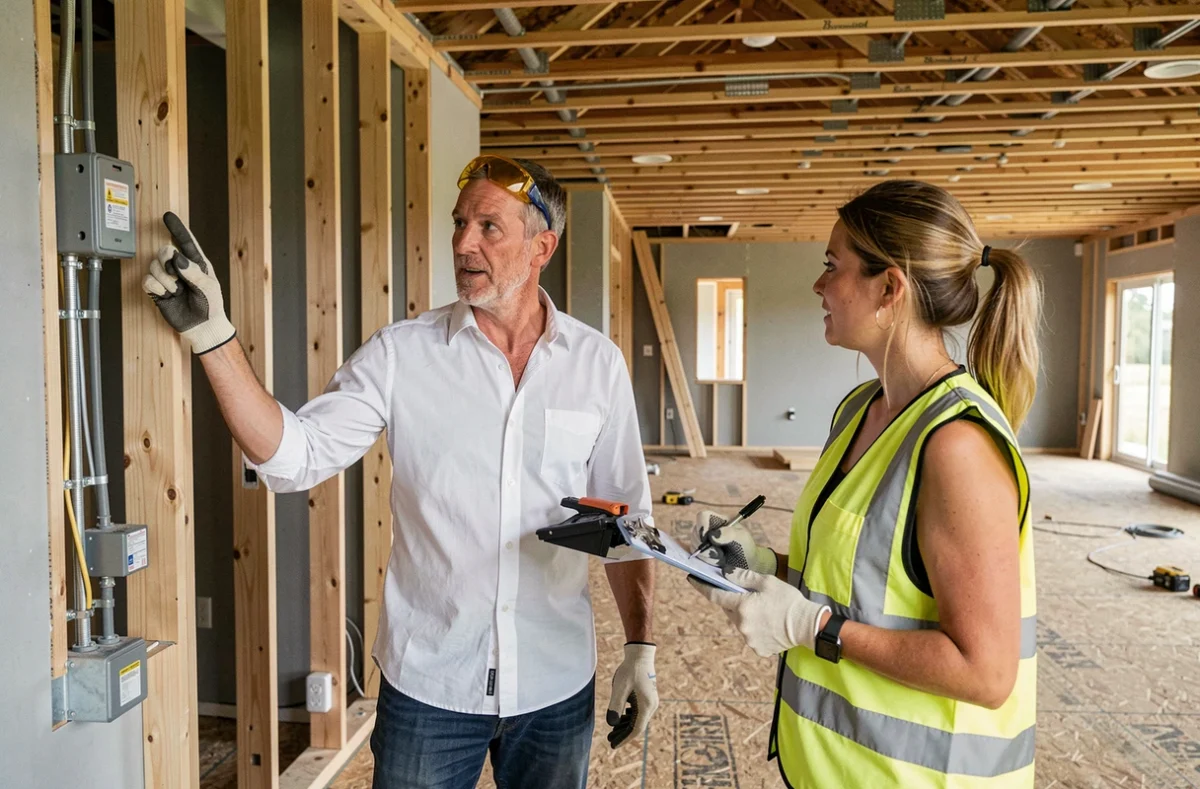
Work Reception: The True Starting Point for Legal Guarantees
Reception is not the handover of keys. This common confusion has direct consequences on the owner’s coverage. Legal guarantees begin from the date of reception, not from the day one moves in.
Three Guarantees, Three Distinct Durations
- The perfect completion guarantee covers all reported defects for one year after reception, regardless of their nature.
- The good functioning guarantee protects detachable equipment elements (shutters, radiators, plumbing) for two years.
- The ten-year guarantee covers damages compromising the building’s solidity or rendering it unfit for its intended use for ten years.
The reception report must accurately list each observed defect. A visible defect accepted without reservation may no longer be covered by the legal guarantees. Taking the time to inspect each room, each connection, each joinery before signing this document is not perfectionism: it is legal protection.
The Additional Eight-Day Period in CCMI
When an individual signs a contract for the construction of a single-family house (CCMI) and receives it alone, without the assistance of a professional, they have a safety net often overlooked. They can report additional reservations by registered letter within eight days following the handover of keys.
This period allows for catching defects discovered afterward, such as a waterproofing issue visible only after the first rain or an electrical malfunction detected during use. The registered letter with acknowledgment of receipt serves as proof of date. After this period, unreported apparent defects may remain the owner’s responsibility.

Construction Budget: Items That Simulators Do Not Show
Establishing a construction budget is not limited to adding the price of the land, the cost of construction, and notary fees. Several peripheral items inflate the final bill without appearing in initial estimates.
- Connection fees to networks (water, electricity, sanitation) vary greatly depending on the distance between the land and existing service points.
- The soil study, made mandatory in certain areas by the Elan law, incurs a cost that the builder does not always include in their quote.
- The construction damage insurance itself represents a percentage of the total construction cost, and its rate fluctuates according to the project’s profile.
- Outdoor amenities (fencing, driveway, landscaping) are almost systematically excluded from the construction contract.
Anticipating these expenses from the financial setup avoids having to make trade-offs during the project between initially planned services. Field feedback varies on this point: some owners experience limited overruns, while others face additional costs representing a significant portion of the initial budget, particularly on plots requiring substantial development work.
Choice of Materials and RE2020: What the Regulations Really Impose
RE2020 regulates the energy performance and carbon footprint of new constructions. For the future owner, this translates into constraints on the choice of materials and heating systems that directly influence the budget.
Wood, for example, benefits from an advantage in the carbon calculation of RE2020 due to its CO2 storage capacity. Bio-based materials (wood fiber insulation, cellulose wadding) follow the same logic. However, the choice of materials must be validated by the thermal study office of the project, as compliance is based on a global calculation, not on an isolated material.
The builder is required to deliver a building compliant with RE2020. However, the project owner has an interest in understanding the trade-offs made: a high-performance heating system can compensate for a less ambitious envelope choice, and vice versa. Requesting the complete thermal study, not just the summary, allows for verifying that the calculation assumptions correspond to the project actually built.
RE2020 compliance is verified upon completion of the work, and a discrepancy between the projected study and the reality of the building can pose problems during delivery. Monitoring technical choices throughout the project, particularly the thickness of insulation installed and the type of joinery used, remains the most direct way to prevent this type of discrepancy.